Business.com aims to help business owners make informed decisions to support and grow their companies. We research and recommend products and services suitable for various business types, investing thousands of hours each year in this process.
As a business, we need to generate revenue to sustain our content. We have financial relationships with some companies we cover, earning commissions when readers purchase from our partners or share information about their needs. These relationships do not dictate our advice and recommendations. Our editorial team independently evaluates and recommends products and services based on their research and expertise. Learn more about our process and partners here.
Learn how to respond to workplace changes, support your team and build adaptability through everyday decisions.

Adaptability has advantages both personally and professionally. When you’re adaptable, you can handle changes with grace, determination and rationality. Learning how to embrace change can have a positive impact on your physical and mental health. Let’s examine how adaptability can make you a better employee and leader.
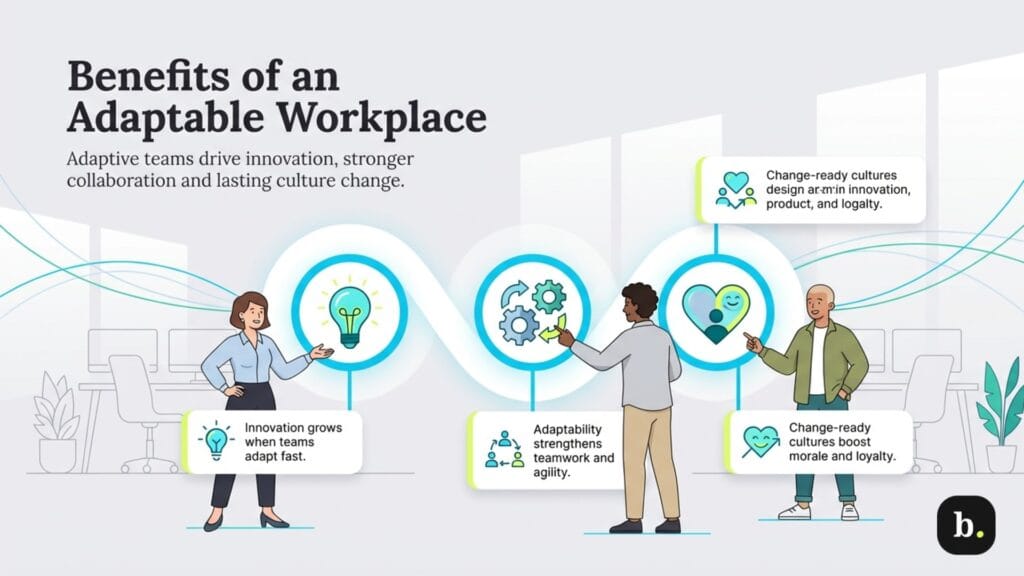
Adaptability is the ability to adjust your thinking and behavior when circumstances change. In business, that can mean revising a sales plan, learning a new process or changing how you support an employee. Being adaptable also means recognizing when an established approach still works and when the evidence calls for something different.
Demand for these skills is substantial. In the World Economic Forum’s Future of Jobs Report 2025, 67 percent of surveyed employers identified resilience, flexibility and agility as core workforce skills.
Here are three ways adaptability can help you at work:
Employers increasingly want workers who can adapt to an ever-changing workplace. Someone who’s adaptable is open to new ideas and doesn’t need to do things a specific way just because that’s how they’ve always been done. They can anticipate changes and don’t panic when things don’t go according to plan.
Businesses already value this trait, but it’s become even more important with the rise of remote work and artificial intelligence. HR directors and recruiters are actively looking for new hires who can display adaptability as a top soft skill. If you want to gain a competitive edge over fellow job seekers while securing marketable skills for the future, start practicing adaptability now.
Adaptability skills are being taught in early childhood education to prepare kids for the ever-evolving future of work.
Adaptable people excel as leaders. They earn the respect of their peers, inspire those around them to embrace change, and help grease the cogs in the wheel of even the stickiest transitions. As a leader, you’re bound to face situations that require you to make quick decisions. If you can pivot quickly and get the rest of your team on board, you can mitigate the potential adverse effects of the change. This ultimately benefits the organization as a whole.
Learn how to test for leadership ability.
A change can still be frustrating or stressful even when you handle it well. Adaptability gives you options: You can ask for help, learn a missing skill or negotiate a more realistic deadline. Focusing on a useful next step can help you regain a sense of direction.
When a plan changes, identify what stays the same: the customer need, the budget limit or the quality standard. Then decide which parts of your approach can change.
Being adaptable has many benefits in the workplace. Here are some of the top advantages.
An organization’s ability to adapt can be considered a competitive advantage. According to research from the University of Illinois, “Performance should concentrate on adaptability and a broader interconnected skill set.” The research found that adaptability is a key driver in helping companies grow and meet goals. This is especially important as strategies shift to meet changes in how business is conducted.
Hiring for adaptability means looking beyond a candidate’s claim that they work well under pressure. Ask them to describe a time they had to learn an unfamiliar task or revise a plan after receiving feedback. Follow up on what they changed, who helped them and what happened.
Leaders can make change easier to navigate by separating what is known from what is still being decided. An effective leader can quickly explain the business problem, invite input from the employees closest to it and establish a date to review the results.
When you’re adaptable, you’ll learn how to manage and lessen the stress resulting from a career change. You’ll stop putting off what you need to do for professional growth and future success. Adaptable people are more willing to explore outside their comfort zone, take risks and embrace uncertainty, with the understanding that transitions are a normal part of life.
A study published in BMC Psychology found that workers with greater adaptability tend to be more engaged at work. The research indicated that when employees’ values and goals align well with their company’s culture, it helps explain why adaptable people perform better in their roles.
Bad things happen to all of us. But if you’re adaptable, you take adversity in stride, never letting it destroy you. Instead, you adjust your thoughts and expectations to suit your new reality rather than dwelling on what could have been. Being adaptable means being resilient, and resilience will get you far in life. Challenges won’t seem all that challenging when you’ve built a tolerance for accommodating changing circumstances.
For organizations, adaptability involves more than encouraging employees to be flexible. Leaders need ways to gather feedback, test ideas and turn successful adjustments into repeatable practices. Those habits can support innovation and collaboration.
Instead of defending a process simply because it is familiar, an adaptable team can consider how they might solve a customer problem. Nurture such creativity by offering employees a specific problem to investigate, room to propose alternatives and a way to test an idea on a small scale.
For example, a service business receiving complaints about appointment delays could trial a different booking process with one team. Compare wait times, missed appointments and staff workload before expanding the change. Experimentation is more useful when you define what success looks like and act on the results.
People who are afraid of growth and reluctant to seek help limit their adaptability. Having long-term goals and leaning on mentors can motivate your team to explore ideas and turn them into reality. Curiosity and attention to business processes, expansion and employee culture can help you outperform your competition.
Delegation is crucial when you’re ushering in a series of changes. Utilizing each team member’s strengths allows you to pivot with little downtime and few bottlenecks. By delegating tasks, you can achieve your goals faster, moving your business forward as everyone adapts to the new plan. [Read related: What Does Your Turnover Rate Tell You?]
Workplaces that teach and promote adaptability inspire their workforces to grow mentally and emotionally. Teams that adapt well to change can improve collaboration, communication and the overall daily working environment. Employees who are part of a positive company culture are more likely to be loyal workers, maintain better physical and mental health, and aspire to become leaders within your organization.
Studying the psychology of organizational change can help you be a better leader in the workplace.
Building adaptability takes practice with real problems. Start with one change you or your team are facing, then identify the thinking, motivation, actions and relationships needed to respond.
A framework published in PLOS One organizes skills that support adaptation into four categories, called C+MAC. It offers a way to discuss development needs:
This framework gives individuals and organizations a clear roadmap for building adaptability skills that can be measured and improved over time.
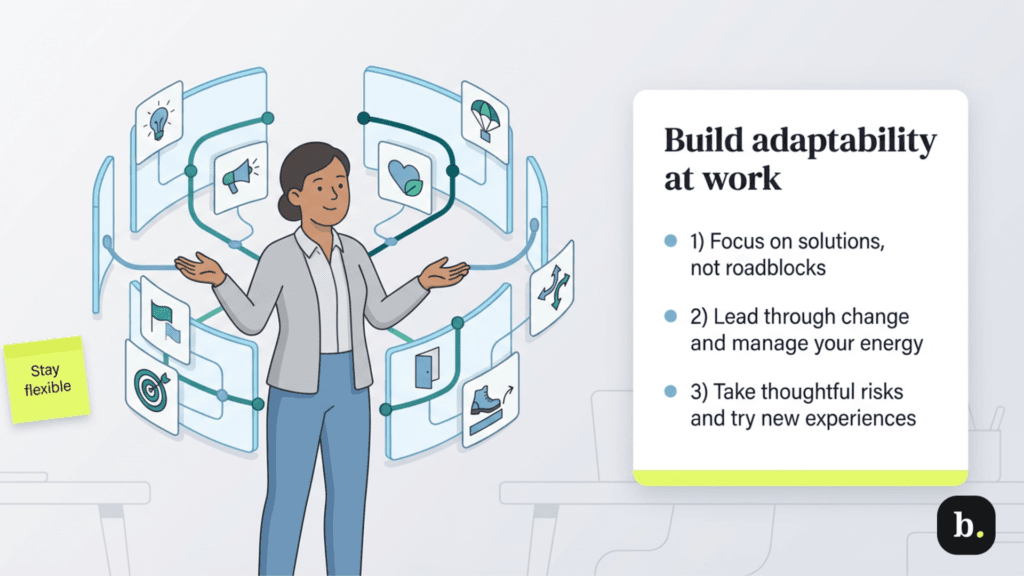
Here are tips to develop your adaptability:
Challenge your brain to come up with innovative solutions to seemingly insurmountable problems. When you believe there’s always a solution to your problems, you train your brain to think about resolutions instead of roadblocks. You begin seeing the opportunities and silver linings — instead of the burdens and problems — in difficult situations. This mindset switch will improve your critical-thinking skills.
Read related article: Give Your Brain a Boost with Books Guaranteed to Make You More Intelligent
Changes in the workplace are inevitable. How you handle those changes can show whether you’re a leader or a follower. Help team members see the positive side of change. Show confidence in decisions instead of worrying about the outcomes. Focus on increasing communication to keep people on the same page and improve efficiency. Take an active role in what’s going on rather than letting things just happen.
Reach out for support when needed, take time to regroup and let others know it’s OK to ask for assistance through transitions. While you deal with the practical implications of a change, continue attending to your own needs. If you manage others, review workloads and deadlines as part of that support.
Self-care can improve productivity, so being mindful of your well-being can help you professionally.
If your business is growing quickly, your team is expanding or unexpected opportunities come your way, don’t shy away from those changes. Taking risks can be scary when you rely on a steady paycheck and have established routines, but the alternative can be that you’re left with what-ifs and regrets. Instead of seeing change as overwhelming and all-encompassing, take it one step at a time and consider all that you have to gain.
Your business may thrive on established processes, but it is useful to check whether those processes still meet your needs. Seek views from people who use them every day and consider evidence that challenges your preferred approach. Asking what would change your mind can help you build critical-thinking skills.
While the ego is not good or bad, it is naturally self-centered. Removing this perspective helps you see other viewpoints and deal with change more efficiently. Sometimes we like to control every situation, but setting your ego aside allows you to welcome other outcomes — possibly better ones. Accepting outcomes beyond your control can help you adapt quickly to unforeseen circumstances.
Staying comfortable and steadfast to routine can make you less adaptable when there are changes beyond your control. Diversify your daily experiences so you don’t get stuck in a rut. Even trying a new restaurant or taking an impromptu personal day can help renew your creative spirit. Business owners need to control their stress, which may mean adopting new practices and making last-minute adjustments instead of remaining in their comfort zone to their own detriment.
Learn how stress impacts productivity.
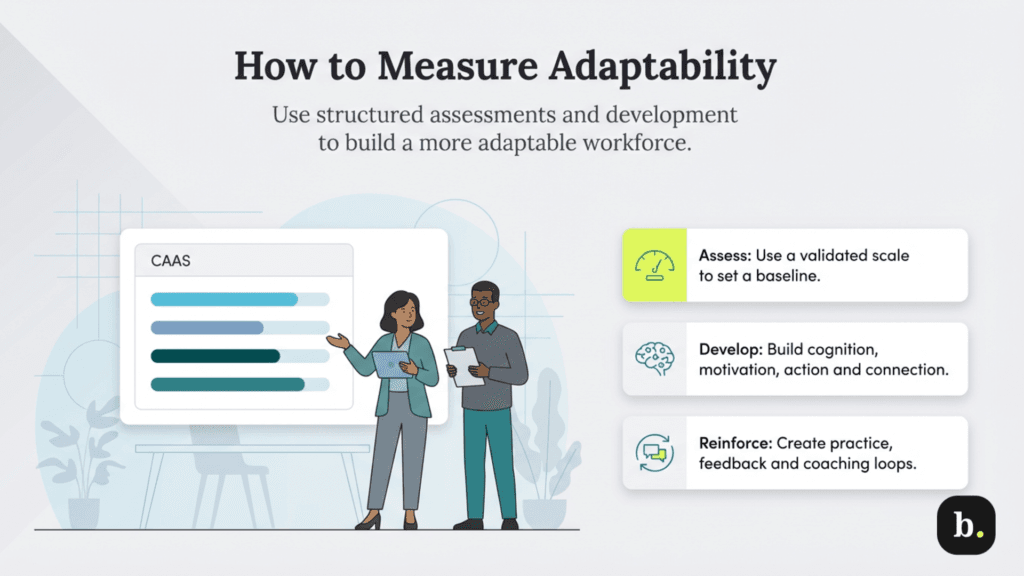
The Career Adapt-Abilities Scale (CAAS), developed by Mark Savickas and Erik Porfeli with an international research team, is one way to measure adaptability. It uses four key dimensions:
This scale has been validated across different cultures and populations, providing a reliable way for individuals and organizations to assess adaptability levels and track improvement over time.
Organizations looking to build adaptability can implement a structured approach:
The World Economic Forum’s report estimated that 59 of every 100 workers would need training by 2030. That projection reinforces a practical priority for business owners: Give employees time and resources to learn as their work changes.
The research is clear: adaptability is not just a nice-to-have skill— it’s essential for thriving in today’s dynamic workplace. By developing the cognitive, motivational, action-oriented and connection skills that support adaptability, you can turn uncertainty into opportunity and change into competitive advantage.
Shirley Tan contributed to the reporting and writing in this article.


